

(This article was originally published on May 25, 2025 on my LinkedIn profile.)
I’ve been working with artificial intelligence in one way or another nearly my entire career, or at least since the advent of search engines.
From the early days of search optimization, to navigating email spam filters and sender scores, to social media engagement algorithms and now to generative AI, I’ve been dealing with the communication and discoverability ramifications from the beginning.
Three Shifts In Consumer Behavior
There have been two major shifts in changing technology-driven consumer behavior during my career.
1. Keyword Search
The first was search engines making it much easier to find the infinite resources of the internet. Before search engines, people shared web sites they liked on Usenet Newsgroups, via private email lists, media coverage, “What’s New” pages detailing websites that had just “joined” the internet, and website directories of which Yahoo was the most popular.
Then in the mid-nineties search engines such as Web Crawler, Lycos and AltaVista emerged that indexed the full text of web pages, allowing for keyword searching. These early versions simply matched keywords, requiring the user to sift through pages of results and clicking on links until they found a site that satisfied their need.
It wasn’t until Google came along with its PageRank algorithm that search engines figured out how to rank websites according to searcher relevance. This has been the dominant discovery vehicle since 1998.
2. Social Media Feeds
The second shift was the social media feed that sends you information based on your behavior and connections within the social network. With the algorithmically-driven social feeds like Twitter and Facebook, you didn’t have to search; the algorithm just knew what was important to you based on who you were friends with and what content you engaged with.
The “news” just came to you!
Some would argue that the mobile revolution was a third shift in behavior but it only changed where people accessed information, it didn’t really change how people found information. The underlying behavior remained the same.
3. Conversational Computing
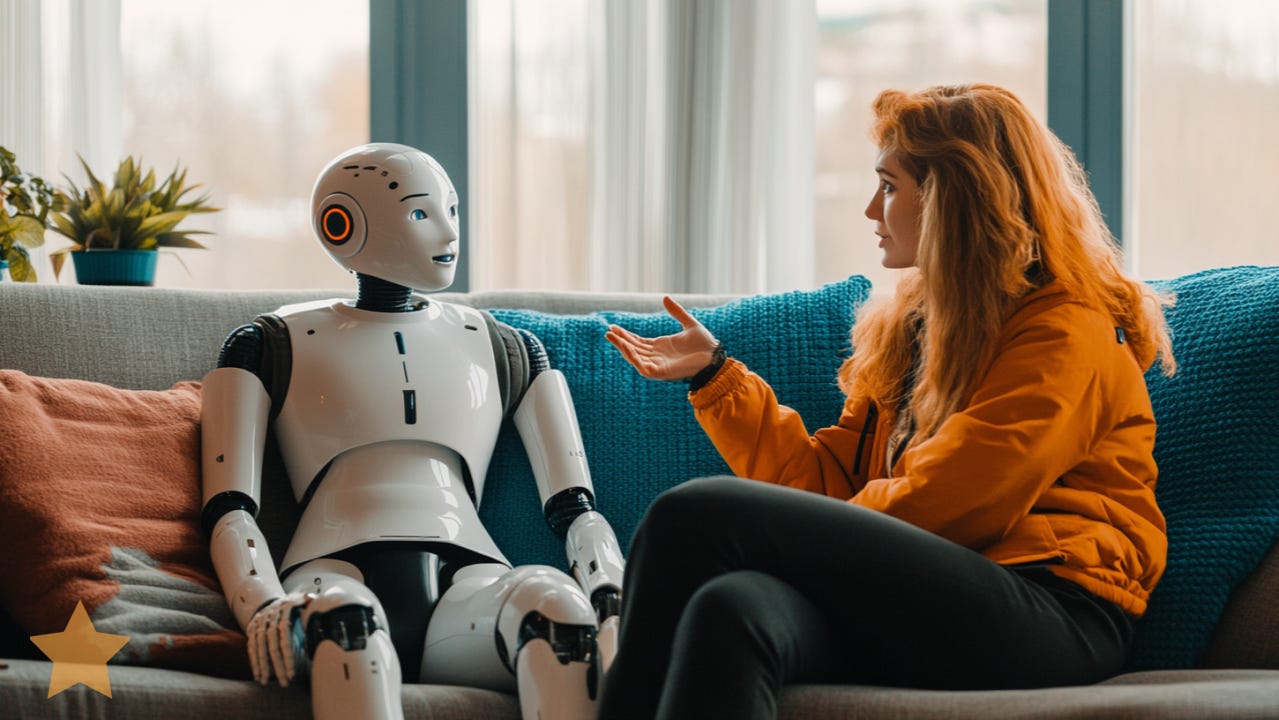
The advent of generative AI is the third major shift in consumer behavior and I contend that it is the most profound. Large Language Model-based (LLM) chatbots offer natural language conversation as a discovery vehicle, especially when coupled with voice-enabled multimodal capabilities.
A Brief History of Communications

To put this shift into context, we need to reflect on the history of communication.
A primary distinguishing characteristic of humans from the rest of the animal kingdom is our ability to pass knowledge on from generation to generation through language coupled with the ability to invent tools.
Let’s start with the caves. Back in the day, pre-civilized human beings told each other stories around campfires and recreated some of those stories on the walls of caves. But the dissemination of that knowledge depended upon proximity to both the campfire and to the walls.
As we migrated out of the caves and settled into agrarian communities that traded with other communities, we needed accounting systems to manage that commerce and thus the Summerians invented cuneiform script dating to 3100 BCE.
Fast forward to 1440 and Johannes Gutenberg’s printing press, making knowledge far more portable and durable to survive beyond living generations.
The broadcast era ushered in the capability to instantly transmit knowledge across the world to mass audiences.
Which brings us to the computer age.
The one consistent trend of the computer age has been increasingly effortless input on behalf of the user.
Early computers depended upon tape and punch cards as input devices. The next evolution of computers depended upon users typing in commands via a keyboard and a monochromatic screen.
We graduated from command lines to graphical user interfaces and point and click behavior using a mouse. Mobile devices introduced touch screens. And now, with the sophistication of speech-to-text and text-to-speech technology, we can just talk to computers.
AI chatbots and natural language processing are the fulfillment of the academic paper that really got me interested in this career path. “The Computer for the 21st Century” [PDF] was written by Mark Weisner and published in Scientific American. It describes the moment we are approaching right now with multimodal large language models.
Chatbots are Changing Consumer Behavior
That’s a long way of saying that ChatGPT and Gemini and Claude are changing consumer behavior.
The Generative AI Customer Journey
New research from Adobe Analytics reveals how routine user behavior is changing due to the introduction of AI-driven chat.
Here’s Adobe’s methodology:
“The Adobe Analytics insights are based on direct transactions online, showing the impact of generative AI on the digital economy. The retail insights, for instance, are based on analysis of more than 1 trillion visits to U.S. retail sites, a greater volume of data than is available to any other technology company or research organization. A companion survey of more than 5,000 U.S. respondents provides an additional layer of context on how consumers are thinking about AI in their daily lives.”
It’s not just us early-adopters that have embraced generative AI:
“Between Nov. 1 and Dec. 31, 2024, traffic from generative AI sources increased by 1,300 percent compared to the year prior (generative AI traffic was up 1,950 percent YoY on Cyber Monday). The trend has persisted beyond the holiday season. In February 2025, traffic from generative AI sources increased by 1,200 percent compared to July 2024. This shows the shift in consumer behaviors over a seven-month period. And while generative AI traffic remains modest compared to other channels, such as paid search or email, its growth has been notable — doubling every two months since September 2024.”
And here’s what normal people are using AI for:
39 percent have used generative AI for online shopping,
with 53 percent planning to do so this year.
The shopping tasks consumers are using generative AI for include:
Conducting research (per 55% of respondents),
Receiving product recommendations (47%),
Seeking deals (43%), Getting present ideas (35%), Finding unique products (35%) and
Creating shopping lists (33%).
And when AI chat users finally arrive at a website, they are more engaged:
“Compared to consumers coming from non-AI traffic sources (including paid search, affiliates & partners, email, organic search, and social media), consumers coming from generative AI sources show 8 percent higher engagement as they linger on the site for a longer period of time. These visitors also browse 12 percent more pages per visit, with a 23 percent lower bounce rate.”
When you consider that these users have likely already done most if not all the research they need with the chatbot, these numbers are entirely reasonable. These are qualified leads.

This is the first research I’ve seen that documents how ordinary people who are not as AI-obsessed as your author are using generative AI for everyday purposes. It aligns with the shift away from search engines and toward chatbots that I believe is coming.
The use of AI chatbots really messes with the traditional customer journey we marketers have been using for years. Most of that journey will likely occur directly within the chat session because for most use cases, all the necessary knowledge to satisfy the users’ need will reside within the LLM.
Chatbots Are Not Dominant…Yet
Rand Fishkin of SparkToro has the receipts.

I have no doubt that these numbers accurately represent the current market share. But I’m also confident that traditional search market share dominance is likely to diminish relatively quickly given the pace of generative AI development and adoption.
Here’s why:
The AI Arms Race Is On
I have never seen a technology as profound and which has improved so dramatically at such a quick pace in my entire lifetime. The competition between the major frontier LLM developers coupled with open source models and innovations such as those introduced by DeepSeek have pushed the pace of improvement quicker and introduced more and more powerful models.
There’s the figurative arms race between developers and then there’s the literal arms race between nations. AI policy, such as it is, is being driven in the current administration by AI accellerationists, so we can expect few if any barriers imposed by the federal government on AI development.
You’ve likely already heard the phrase today is the worst version of AI you’ll ever use.
Consumers Are Still Figuring AI Out
Just as we are at the dawn of the development of AI, so too are consumers at the dawn of understanding just how much value AI chatbots can provide.
Before Google came around, we had to understand how to deploy boolean search operators in order to get the best results out of search results.
Likewise, most consumer users of ChatGPT or Gemini are using zero-shot prompts where they are asking the model to perform a task without providing it with any specific examples of how to do it, let alone any more sophisticated prompt engineering techniques that truly unlock the chatbot’s capabilities.
When consumers start understanding how to extract a lot more value from chatbots or the developers start accounting for a lack of consumer sophistication within their models, those market share numbers will begin to change.
Consumer Skepticism Will Dissipate
Consumer skepticism of generative AI is still fairly strong due in large part to the well-known hallucination problem.
That problem can be mitigated through more sophisticated prompt engineering tactics but model developers are also taking steps to improve the accuracy of chatbot outputs. I’ve seen the improvement myself over time.
Anecdotally, I’ve noticed a wariness of people having a hard time trusting Google’s AI overviews. I doubt it is because people are fact-checking them. I think it is largely due to media coverage of the unreliability of AI results and that media coverage was in turn a result of using earlier, less reliable models.
That said, I’ve noticed the occasional inaccurate Overview myself so I don’t put complete faith in the AI overview feature of Google Search.
But you know what? People make calculations on the degree of risk in trusting an AI overview. If it’s an AI overview about a low-dollar investment, then that is likely to have little effect on the user’s purchase decision. But the higher the monetary investment or the more crucial the information to making a decision, the less likely the user is going to trust the AI overview.
I remember a time when I swore I would not share my credit card information with a website.
Google Is Hedging Its Bets
Google clearly doesn’t want to kill the advertising cash cow that depends upon keyword searches. But it also is a market leader in generative AI and has ambitions to be the market leader.
And Google recognizes what I’m recognizing: That discovery though chatbots is a far better user experience than traditional search.
So, the company is integrating AI into all its products and it is experimenting with integrating generative AI within search via its AI Overviews feature and the new AI Mode search experiment.
(Britney Muller recently published interesting findings from her research using Google’s new AI mode search feature, which lends some insight into at least what Google is emphasizing in AI-powered search.)
Consider also that right now, chatbots are mostly used via text exchanges or audio conversations. In the fairly immediate future, we’ll be able to chat with bots not just on our phones but also via our smart speakers and smart glasses. Effortless input.
So, with a nod to Rand Fishkin’s data and to quote Humphrey Bogart, “Maybe not today, maybe not tomorrow, but soon and for the rest of your life.”
Based on this belief, I have been fundamentally reframing my agency’s digital marketing practices to align with how an organization or brand can be discovered by their key stakeholders via Large Language Models.