

(This article was originally published on January 3, 2025 on my LinkedIn Profile.)
I recently conducted an in-depth survey (nearly 3,500 words) of what some of the leading research firms and AI experts are predicting for this year.
I’d like to share some of the trends I find most interesting from a marketing/strategic communications point of view and a few of my own, based on my experience with artificial intelligence over the years and Gen AI during the last two.
8. AI Resistance

PwC’s 2024 Workforce Radar survey reveals that “41% of executives say that workforce issues, such as training, culture, or change in work are among the top-five challenges their organizations face in using GenAI.”
There is certainly hesitancy to the adoption of Generative AI in the workplace. Some of this is driven by fear of AI replacing jobs.
I experienced this first-hand last year during two SEO events I attended that made it clear that search engine marketing professionals were fearful AI was coming for their jobs.
The backlash from advertising creatives over Coca-Cola’s AI-generated Christmas ad is another example of such fear. Just read the quotes in this AdWeek article and you’ll get a sense of what I mean.
Those fears are not unfounded. Gartner predicts that 20% of organizations will leverage AI to flatten their organizational structures by 2026, eliminating more than half of current middle management positions.
Another behavior I’ve noticed is people dismissing the value of Generative AI because they got poor results after using it like a search engine.
I’ve seen this behavior before when people who didn’t know what they were doing tried out Google search ads, only to get underwhelming results because they didn’t know what they were doing.
You really need training on how to use generative AI if you want to get the most value from it. If you use it like a search engine or ask it to write an article without the proper prompting, it’s no surprise you’ll get meh results.
Until we get acclimated to this new technology and fully understand how to use it, we will continue to see significant levels of resistance to its use.
That may be why Forrester cautions [PDF] that impatience with achieving a return on investment (ROI) could lead some enterprises to prematurely scale back their AI initiatives.
It is critical to acknowledge the communication challenge this presents for leaders.
Organizations need strategic messaging to address both internal fears (e.g., job loss) and external skepticism (e.g., “AI can’t deliver ROI”).
From a strategic comms perspective, companies should double down on storytelling about how AI complements rather than replaces human roles. For example, showcasing real-life “human-machine partnerships” where AI enhances human creativity or productivity could soften resistance.
7. Strategic AI
However, for those organizations that have already devoted time, resources and skill development to using Generative AI, 2025 should be a year of more deliberate and strategic implementation of the technology.
Forrester anticipates a shift towards a more strategic approach to AI in 2025, with an emphasis on business outcomes, data quality, and AI talent development.
Some industries, such as healthcare and finance, have been using artificial intelligence for quite some time, Gen AI being only the most recent variety. These are industries to watch, as their previous AI experience will heavily inform their use of Generative AI.
My work at Tunheim during the past year was heavily focused on using generative AI for insights into industries, markets and audiences to supercharge the communication strategies we develop for clients.
In PR and marketing, the move to strategic AI will require agencies to shift focus from simply generating outputs (content, insights) to embedding AI into workflows. This could mean:
Using Gen AI for rapid scenario planning during crisis comms, or
Leveraging AI for hyper-personalized audience segmentation.
This will likely create new competition among agencies, favoring those who invest early in AI training and talent development.
6. Use Of AI in Marketing Gets More Sophisticated
Michael (Mike) Stelzner of Social Media Examiner recently surveyed 1,250 marketers about their use of Generative AI and found that “nearly two-thirds are using generative AI tools either daily or weekly, with 37% using AI each day.”
While the adoption rate among marketers is high, the tasks they use it for are fairly predictable if somewhat surprising to me.
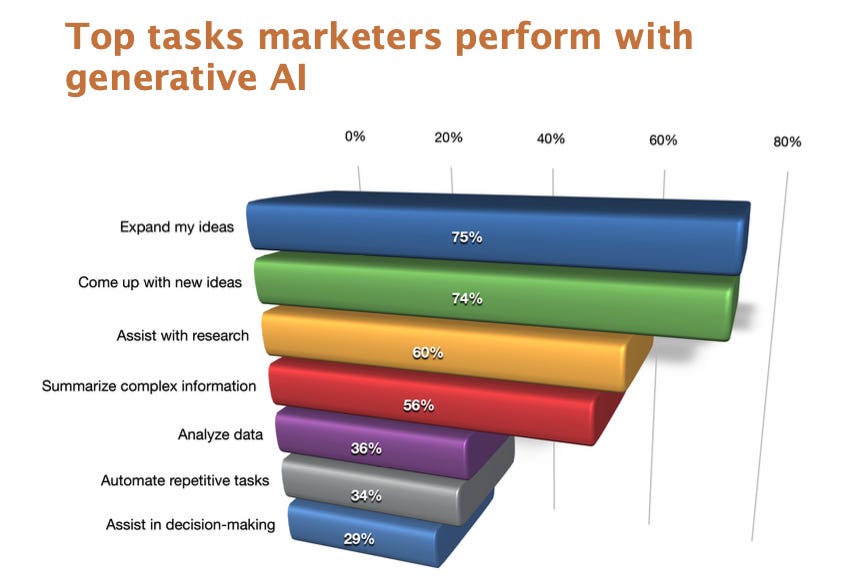
Creative professionals using Gen AI as a brainstorming partner is a pretty obvious use case, as are research assistance and content summarization.
I would’ve expected to see a bit more sophisticated use of generative AI among marketers. That could just be because 62% of the respondents have used Gen AI for less than a year, so they haven’t yet come to understand the full capabilities of this technology.
But if most of the tasks they are applying Gen AI to are content-related, they are barely tapping the surface of the value this technology provides. I expect marketing and strategic comms use cases will expand in 2025.
5. No Code Software Development
McKinsey predicts that AI’s ability to auto-generate code based on natural language inputs will significantly influence software development.
This will empower entrepreneurs and creators without technical backgrounds to develop software solutions, potentially leading to a surge in lean, agile startups.
I’ve seen this in action directly.
While I’ve got some programming chops, it is not a skill I practice daily so when I do have to program something, I’m often hacking or having to do some research to refresh my memory.
This past year, I built a couple of custom GPTs to help:
One to generate schema code based on user input, and
Another web development expert bot that has saved quite a bit of time on several occasions.
We’re already seeing Generative AI incorporated into programming tools like GitHub CoPilot and Cursor, an AI code editor.
We will likely see a surge in niche marketing tools developed by creatives rather than technologists, democratizing the martech space. For communicators, this means two things:
You’ll need to stay sharp about integrating niche tools into campaigns, and
There’s potential to build proprietary tools for clients, increasing value.
I’ve got countless ideas for apps I’d like to build. I’m looking at 2025 as a year when I’ll actually try and use Generative AI to build some of them.
4. Not Quite Agentic AI
AI agents are all the buzz. If you’ve been following the news about AI at all, you will have run across numerous headlines proclaiming 2025 to be the year of Agentic AI.
The AI platforms haven’t exactly been muting the hype, either, as it’s good investor content.
It appears that Gartner has bought into the hype, as the company predicts that by the end of 2025, 40% of knowledge workers will rely on AI agents daily, freeing up time for strategic initiatives.
A more tempered assessment comes from experts from the Stanford Institute for Human-Centered AI who predict a shift towards collaborative AI systems in 2025.
To be fair, we have seen glimpses of Agentic AI. Anthropic introduced a “Computer Use” feature of its Claude AI chatbot in October that can not only browse but also interact with websites. But even that, amazing as it is, still requires explicit instructions.
True Agentic AI will have autonomy to get stuff done on its own without a lot of human supervision or direction.
The technology is just not there yet. Here’s an example:
I email a lot of articles to myself at my Gmail address. I include the headline of the article in the subject line along with a hashtag related to the article. So, if it’s about AI, I’ll add #ai to the subject line so I can filter all the AI articles for later use.
I also include a blurb from the article and the link to the article in the body of the email.
I wanted to use Gemini–which has an extension that gives it access to my Gmail account and my Google Drive–to give me all the AI articles in my inbox during the past month and turn it into a digest that includes the article headline, date, source, and URL and save that as a document in my Google Drive.
After several different attempts, I gave up. The closest I got was a fairly decent digest of half a month’s worth of articles written out in the Gemini interface itself but never saved as a Google Doc.
Also, it threw in a couple of Medium articles about AI that I never emailed myself. Close, but no cigar, Gemini.
I’d love to get it to work consistently but such a function is better categorized as an AI assistant than Agentic AI. It is, however, a step in the direction of Agentic AI.
Another example is Google’s Deep Research Gemini model released last month that will do just that, conduct deep research on your behalf.
And OpenAI is expected to release Operator this month, an AI assistant that will be able to use a browser.
So, the rollout of Agentic AI in 2025 will likely be incremental.
At this early stage, it is incumbent upon PR and comms professionals to establish ethical frameworks and workflows to govern agent actions.
3. Synthetic People

I first discussed the concept of virtual people in 2011 on a Daily Numbers podcast episode with my friend Pat Lilja. The talking point was about Japanese virtual pop star Miku Hatsune, who, as a hologram, was selling out auditoriums in Los Angeles at the time.
In 2018, my Beyond Social Media Show co-host ...B.L. Ochman and I discussed the rise of virtual influencers Lil Miquela and Shudu Gram, two creative agency concoctions with millions of Instagram followers.
Last August Google acquired the top talent from the popular AI character platform, Character.ai. Synthesia is a growing company that enables AI-generated doubles for B2B companies.
Now, Meta is going to roll out tools for people to create AI versions of themselves that live in the Facebook/Instagram universe.
Meta did try this before with AI versions of Tom Brady, Snoop Dogg, and other celebrities and the result was pretty underwhelming. I tried them out and was like, ugh, whatever. Not too engaging.
I think a lot of it had to do with Meta’s Llama LLM, which was not very impressive. It is used in my Meta Ray-Ban glasses, and, again, not impressed. Half the time it can’t accurately tell me what I’m looking at.
Still, though I’ve yet to give them a whirl, the latest Llama open source models have been earning raves, so I’m not counting out Meta’s new attempt at AI characters.
2. AI Vision Goes Mainstream
Google previewed Project Astra at the company’s I/O conference in May, its general purpose AI assistant that can see and hear in real time. OpenAI also revealed its multimodal capabilities in May.
It took both companies a long time to actually deliver.
Last month, I experimented a bit with Google’s Multimodal Live API with Gemini 2.0 with impressive results.
I gave the system instructions to be a marketing persona I’d built for a client and then had it review the client’s website for its reaction to design, messaging, likelihood to act on a given call to action.
Live, multimodal AI could revolutionize usability testing, audience analysis, and creative evaluation.
This will become a standard operating procedure for my agency in 2025.
I expect live multimodal AI to go mainstream in 2025. Last May, I wrote about what live, multimodal AI might look like longer term.
1. Infinite AI Memory

One of the aspects of the development of Large Language Models (LLM) I’ve been paying close attention to is the size of the context window.
Think of the context window as the size of the AI system’s memory. If you’ve ever had a long session with an AI chatbot that ends up going off the rails, it’s probably because it has exhausted its context window. It’s forgotten portions of the previous conversation you’ve had with it.
Context windows are measured in tokens, which, in LLM parlance, are words or bits of words. OpenAI’s GPT 4o model has a context window of 128,000 tokens, which translates into about 96,000 words.
Google’s Gemini 1.5 Flash model, for comparison, has a one million token context window while its Gemini 1.5 Pro model has a two million token context window.
According to Yahoo Finance, Mustafa Suleyman, the CEO of Microsoft AI, disclosed that Microsoft AI was developing technology with near-infinite memory capabilities, expected to be available by 2025, allowing AI to retain information indefinitely, transforming user engagement.
That would be quite the development.
An infinite context window would have obviously massive implications in terms of what you could do with such a model, especially having it analyze mind-boggling amounts of information.
But also think of what it would mean for an individual user. Setting aside the staggering privacy implications for a moment, think about all the ways that Google has to know things about me.
I use Chrome, so it knows what websites I visit,
I use Gmail, so it has access to my inbox,
It knows what searches I perform,
It knows what videos I watch,
I have YouTube TV, so it knows what shows I watch,
I use Google Maps, so It knows where I live and where I go,
I use Google Drive, so it knows what I write,
I use Google Photos, so it knows the pictures I take,
I use Google News, so it knows my media consumption, and
It has access to my calendar and my contacts.
In short, it knows pretty much everything about me. With all that data about me at its disposal, the responses its AI system can give me could be insanely personalized.
Add to that the ability of the AI system to remember things across sessions or even years.
If you think Google’s advertising system is good at matching companies and prospects, wait till you get a-hold of this monster!